A liveaboard diving trip offers divers access to remote reefs, walls, currents, and delicate marine environments. That is why understanding the frog kick vs. the flutter kick matters. The right finning technique can improve control, reduce fatigue, protect coral, and make each dive safer and more enjoyable.
What Is the Flutter Kick?
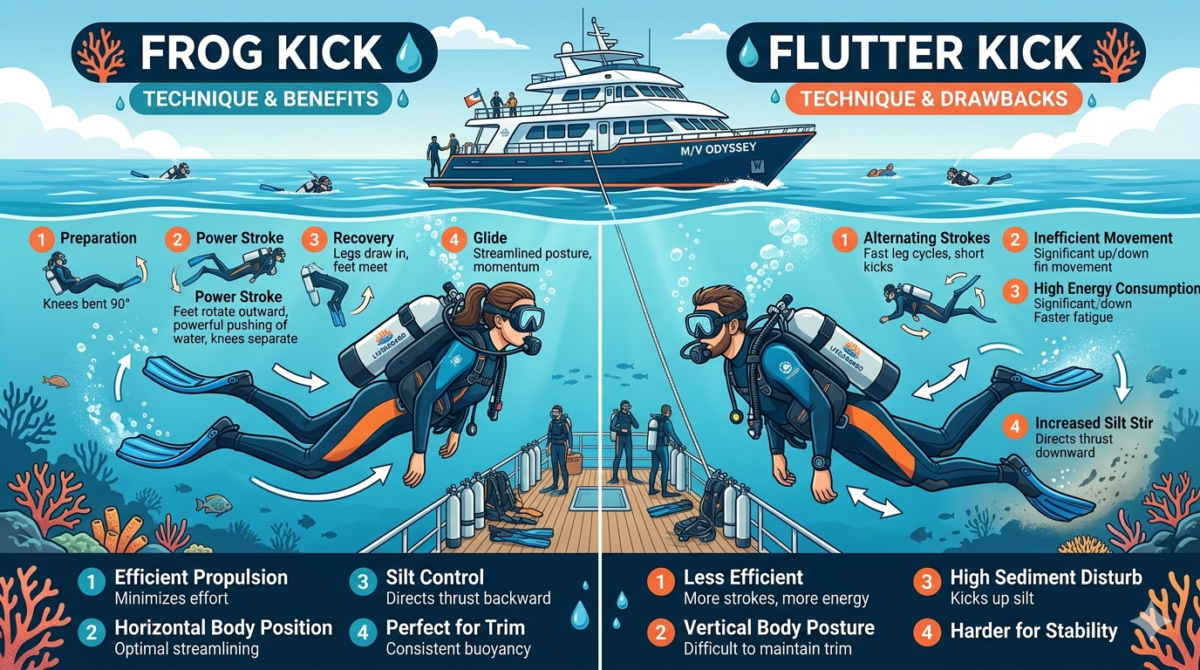
The flutter kick is the most common finning technique taught to beginner divers. It uses an alternating up-and-down leg movement, similar to freestyle swimming. When performed correctly, the power comes from the hips and thighs, not from bicycle-style knee movement.
The main advantage of the flutter kick is speed. It is useful when you need to cover distance, move through open water, or maintain momentum in mild current. For divers joining a dive cruise or exploring wide channels, flutter kick can feel natural and efficient.
However, the biggest drawback is environmental impact. A wide flutter kick can push water downward, stir sediment, or accidentally hit coral if the diver is too close to the reef. This makes it less ideal for fragile reef slopes, muck sites, or underwater photography.
What Is the Frog Kick?
The frog kick uses a wide outward sweep of the legs followed by a glide. Instead of pushing water downward, the motion pushes water backward, helping divers move forward with better control. This is why many experienced divers prefer the frog kick during a liveaboard diving itinerary with multiple reef dives each day.
The frog kick is slower than flutter kick, but it gives excellent stability. Divers can pause, glide, and adjust position without constantly kicking. This makes it useful around coral gardens, sandy bottoms, wrecks, and tight swim-throughs.
The downside is that it requires practice. Divers need good trim, relaxed breathing, and proper fin positioning. Without control, the kick can become too wide or inefficient.
Frog Kick vs Flutter Kick for Reef Diving
For reef diving, frog kick is usually the better choice. It helps keep the fins higher, reduces downward water movement, and lowers the risk of touching coral. This is especially important in sensitive destinations where reefs are a major part of the experience.
Indonesia is one of the world’s richest marine regions. The Coral Triangle contains 76% of the world’s coral species, while Raja Ampat alone has hundreds of coral species and more than 1,300 coral reef fish species. In places like a Komodo dive site, Raja Ampat diving, or scuba diving Sulawesi, careful finning is not just about comfort. It is part of responsible diving in Indonesia.
A diver with strong frog kick control can hover near reef edges, approach marine life calmly, and avoid creating clouds of sand or silt. For photographers and videographers, this is a major benefit.
Pros and Cons of Flutter Kick
Flutter kick is best for distance, speed, and open-water movement. It works well in current, during descents, or when following a guide across a larger site. It is also easy to learn, which makes it practical for newer divers.
The cons are control and reef safety. Flutter kick can disturb sediment and marine life when used too close to the bottom. It can also increase air consumption if the diver kicks too hard. During komodo diving, komodo island diving, or diving komodo, where currents and reef structures can vary, divers should use flutter kick carefully.
Pros and Cons of Frog Kick
The frog kick is best for control, reef protection, positioning, and energy conservation. It works beautifully from a diving boat, especially when divers enter the water several times a day on liveaboard trips.
The cons are speed and learning curve. It is not the fastest method, and some divers may find it difficult with very flexible fins. Still, for a diving liveaboard journey through coral-rich areas, frog kick is often the more useful long-term skill.
Best Use Cases for Each Technique
Choose flutter kick for open water, stronger current, surface swimming, and covering distance. Choose frog kick for reefs, photography, silty bottoms, relaxed cruising, and close control.
This applies across many Indonesian routes, from a Raja Ampat diving trip and Raja Ampat liveaboard to Komodo liveaboard, Banda Sea liveaboard, Triton Bay liveaboard, Halmahera liveaboard, and Indonesia liveaboard experiences.
Divers planning Sulawesi diving, North Sulawesi diving, best diving in Sulawesi, Banda Sea diving, Banda Islands diving, Banda diving, Halmahera diving, Triton Bay diving, or a Raja Ampat diving liveaboard should practice both techniques before departure.
Which Finning Technique Is Better?
There is no single winner for every condition. Flutter kick is better for speed and distance. Frog kick is better for control, reef protection, and precision.
For reef-focused trips, frog kick is usually the smarter default. It supports better trim, cleaner movement, and a lower chance of damaging fragile marine life. For current-heavy dives, flutter kick still has a place.
The best divers know both. Whether you join an Ambai liveaboard, a Seahorse liveaboard, a Wallacea dive cruise, a Raja Ampat boat tour, the best Raja Ampat liveaboard, a luxury liveaboard diving journey, a diving yacht, or the best diving liveaboard, mastering both techniques will make every dive smoother, safer, and more respectful.